
What to Know
Most learning in school takes place through the medium of language, and most students who struggle in school have difficulty in some area of language. The struggle may be in the area of perception, processing and comprehension, or organization and production. It may be in all three. A basic understanding of the language of language can help orient us to LBLD and where students may experience problems. Language skills can be categorized into four interrelated areas: listening, speaking, reading, and writing. Listening and reading comprehension are receptive language skills, while speaking and writing are expressive language skills. Figure 2 shows the relationships.
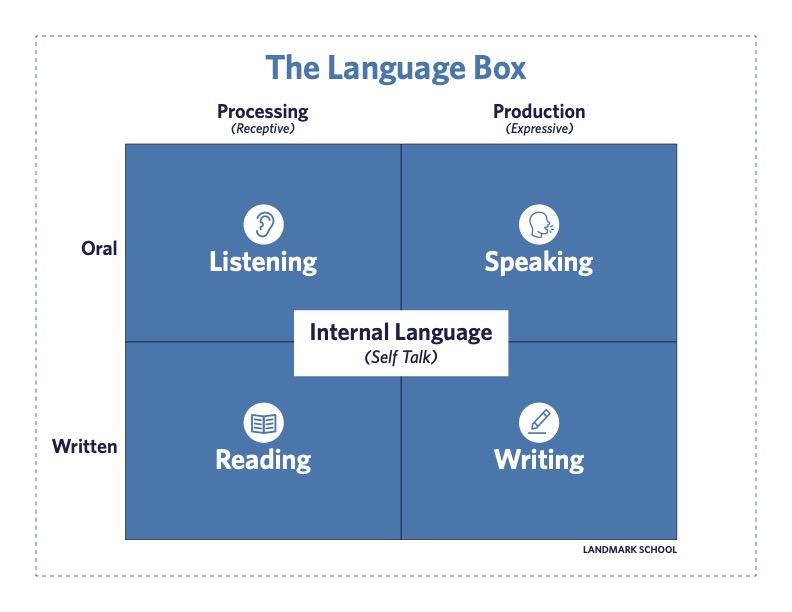
Figure 2. The language box.
The areas of language develop in an overlapping way, and interference in the development of one area can cause difficulty in others. For instance, students who do not read fluently or frequently do not develop as robust a vocabulary or fund of knowledge as their peers. If their difficulty is in the area of processing language (e.g., dyslexia) and they do not receive appropriate remedial instruction, they may never catch up with their fluently reading peers (Shaywitz, 2003, p. 34). They may have increasing difficulty with comprehension, and their writing may fall below age-appropriate expectations. The gaps widen over time. This phenomenon, known as the Matthew effect (Merton, 1968; Stanovich, 1986), highlights the importance of identifying the causes of school difficulty early on and not assuming that a student will outgrow the difficulty. Early identification and appropriate intervention can prevent these widening achievement gaps.
Facets of Language
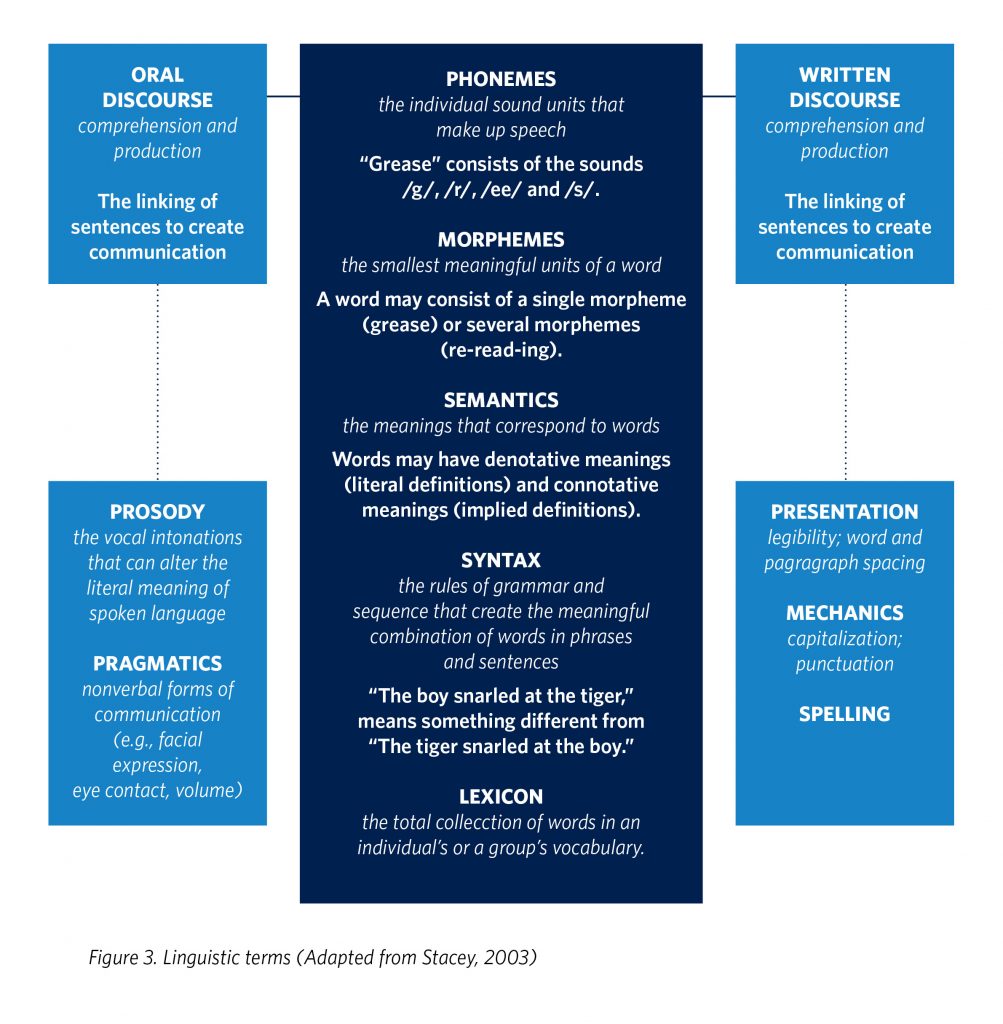
Language becomes coherent communication through a dynamic interaction of its facets. From the smallest speech sounds, called phonemes, to complex communication, called discourse, our brains are constantly perceiving, processing, managing, and producing language in order to learn and communicate with others. Figure 3 summarizes important linguistic terminology.
Executive function is key in the mastery of language skill because it coordinates the cognitive and psychological processes necessary for effective communication. Likewise, language skill supports executive skill development because executive function is mediated by our capacity to use productive internal language. To a great extent, proficiency in the areas of language (listening, speaking, reading, and writing) depends upon executive function and mastery of the five linguistic areas (morphemes, phonemes, syntax, lexicon, and semantics) within a framework of understanding and producing oral and written discourse. Additionally, effective oral discourse requires appropriate prosody and pragmatics. Effective written language requires appropriate use of the conventions of written language, including word spacing, capitalization, punctuation, and spelling. For instance, students who struggle to process phonemes may misperceive and misunderstand oral language, mispronounce words, and struggle with reading and spelling. In fact, most reading disorders result from differences in the way the individual’s brain processes phonemes, which helps explain the origins of the term phonological processing disorder. Without appropriate individualized instruction for the phonemic difficulty, language proficiency is impeded.
Student Profiles
Students have unique learning profiles shaped by their educational experiences, learning and thinking styles, personality traits, and specific needs related to language acquisition and use. All students who struggle in school—particularly those with LBLD—benefit from structured, multisensory, skills-based instruction. Each requires individualized instruction tailored to their specific needs. The following student profiles highlight different aspects of five students: Lan, Carlos, Ayanna, Elijah, and Jason. Each faces challenges in school that teachers must analyze and address. These profiles are composites of several real students, with names changed for privacy.
Diagnostic Assessment
As you read about each student’s background and current performance, keep in mind the following questions:
- In what ways does the diagnostic assessment contradict what I know about this student?
- Are there other assessments that provide helpful information?
- What next steps would I take to empower this student?
LAN GRADE 2: She has received reading intervention with increasing intensity since kindergarten but has made minimal progress. She was referred for diagnostic assessment as well as a behavior evaluation. Lan’s cognitive ability scores range from above average to superior and show a wide gap between her verbal (average) and nonverbal (superior) abilities. Her performance on academic assessments does not reflect her cognitive abilities. With the exception of reading, her scores fall in the average range. A behavior evaluation concluded that the trigger for Lan’s difficulties is frustration with making herself understood to her peers and adults. A speech-language evaluation then indicated that Lan has a severe phonological processing deficit and an expressive language disorder.
CARLOS GRADE 4: Several months of various interventions to help CARLOS improve his work quality and homework completion resulted in only marginal improvement, and Carlos resisted the additional help. An educational evaluation found that his verbal and nonverbal cognitive abilities fall in the average range overall. Of note is his superior performance on tasks of visual perception and his extremely low performance on tasks requiring attention, working memory, and processing speed. Academic skills testing indicated performance at or above grade level in all areas. The evaluation included this comment from Carlos: “If I could do all my work in a quiet place and someone told me exactly what to do, I’d be a better student.” Carlos’s parents and teachers completed ADHD questionnaires as part of this evaluation. Results indicate that Carlos’s ADHD is not being adequately addressed and that he is struggling as a result of weak executive function. A plan to re-evaluate his medication and make changes in instruction was recommended.
AYANNA GRADE 6: She decodes above grade level but reads out loud with little inflection in her voice. She has difficulty answering comprehension questions, whether she reads a passage herself or it is read to her. Her teacher invited Ms. L., a speech-language pathologist, to observe class and examine Ayanna’s written work. Ms. L. expressed concerns about Ayanna’s language and social development and recommended a full evaluation. Assessments showed Ayanna’s cognitive abilities to be below average on verbal tasks, average on nonverbal tasks, and significantly below grade level in all areas of academic performance. Further testing indicated that though Ayanna’s dyslexia was remediated in terms of decoding speed and accuracy, her receptive language weaknesses interfere with her comprehension of both written and oral language. The difficulties with oral expressive language and writing skills highlight Ayanna’s difficulties acquiring and using vocabulary, manipulating syntax, and generating clear discourse. She was diagnosed with a receptive-expressive language disorder.
ELIJAH GRADE 8: His diagnostic assessment showed that his cognitive abilities fall in the high-average range, but his weak working memory and slow processing speed interfere with successful performance. Elijah has also been diagnosed with ADHD and exhibits many behaviors consistent with weak executive function, particularly in sustaining effort and focus. Additionally, a speech-language evaluation concluded that Elijah has an expressive language disorder. The combined challenges of Elijah’s ADHD and expressive language disorder make it difficult for him to achieve the level of academic independence expected of an eighth-grade student, especially in terms of homework and longer reading and writing assignments.
JASON GRADE 10: In a recent after-school meeting, Jason’s English teacher asked him to read aloud from the novel the class was studying. Her intent was to show him how to use a quote from the reading to support an assertion about the main character. Jason was unable to read the passage fluently. He explained that reading had always been difficult for him, but that he was able to get by until high school. Jason’s teacher arranged for the special education director to administer a reading assessment. It showed Jason’s decoding skill to be at about the fourth-grade level. Additional assessments determined that Jason’s listening comprehension is quite good, but his ability to express himself in speaking and writing is also limited. The school determined that Jason should receive additional instruction for a time before referring him for a full evaluation. The interventions were not enough to bring Jason’s skills to a proficient level. When an educational evaluation was completed several months later, Jason was diagnosed with a reading disorder and a written language disorder.
What to Do
While all student writers make errors and show room for improvement, oral and written language samples from students with unremediated language deficits often stand out. They are notable for many errors, often in more than one facet of language. Categorizing students’ language strengths and errors provides the information needed to help students improve their skills.
Informal Language Diagnostics
We must understand the challenges that students face when they listen, speak, read, and write if we are to facilitate effective skills instruction. Using the informal language diagnostic below, we can view students’ written work from the perspective of language proficiency rather than content knowledge. Implementing the diagnostic is straightforward:
- Provide two or three writing prompts from which students may choose.
- Ask students to write down their names and the prompt they selected.
- Give students 10 minutes to generate their best-written response.
- Collect the responses.
- After collecting responses, categorize students’ errors and strengths on the blank form provided.
Why Informal Diagnostics Support Effective Instruction
Some writing errors may fall into more than one category. For instance, if a student writes barf for bark, it is most commonly marked as a spelling error without other differentiation. However, the error falls into both the phonological and semantic categories. In terms of phonology, it shows that the student heard the final sound as /f/ rather than /k/ and wrote what she heard. In terms of semantics, the word changes the meaning of the sentence. The dog began to barf is quite different from The dog began to bark. As a student’s error patterns emerge, instruction can be tailored to address the particular weakness.
In the writing sample linked below, the student wrote “condender” for contender, showing that she heard /d/ rather than /t/. Alone, this error might not indicate a weakness in phonological processing, but when a pattern emerges, it should raise concern. For instance, all of the spelling errors in writing sample 1 point to weak phonological processing. It is important to categorize student errors carefully, as the profile that emerges should offer rich information to guide future instruction.
Writing Samples
Explore the writing samples linked below in the “Strategies to Download” section. They were written by high school students and a completed sample diagnostic follows each sample. Both writing samples are from students with LBLD and so illustrate the unique language needs of students who share a diagnosis. While both writing samples have multiple errors in the syntax category, the points made by the first writer are not as clearly stated as those made by the second writer. Similarly, the weaknesses in discourse that the first writer demonstrates are not apparent in the second writing sample. Why? The first writer has an expressive language disorder in addition to dyslexia, while the second writer has dyslexia.
References:
Merton, R. K. (1968). The Matthew effect in science. Science, 159(3810): 56- 63.
Shaywitz, S. (2003). Overcoming dyslexia: A new and complete science-based program for reading problems at any level. New York: Knopf.
Stacey, R. (2003). Thinking about language: Helping students say what they mean and mean what they say. Prides Crossing, MA: Landmark School, Inc.
Stanovich, K. E. (1986). Matthew effects in reading: Some consequences of individual differences in the acquisition of literacy. Reading Research Quarterly 21(4), 360-407.