Explicitly Teach Comprehension Strategies
A useful reading comprehension strategy is to teach students how to find the topic, the main idea, and relevant supporting details. Showing students how texts are organized and helping them understand how that organizational structure contributes to the meaning of the text can help students understand what they read.
Scarborough’s Reading Rope, a theoretical model of reading development created by Hollis Scarborough, highlights that reading comprehension is an active process. Strong readers possess automatic word recognition skills and strategic language comprehension skills, meaning that students who read well can quickly and effortlessly read the words on the page and can also simultaneously deeply and flexibly engage with the language they encounter.
To support reading comprehension, educators must not only teach word recognition skills, but also language comprehension strategies. The language comprehension strands of the reading rope include background knowledge, vocabulary, language structure, verbal reasoning, and literacy knowledge (Scarborough, 2001, figure 8.1 p. 98). To be able to successfully comprehend text, students must be taught essential vocabulary, background knowledge, and strategies to help them recognize how the structure of text supports the meaning. Noted literacy researcher, Timothy Shanahan asserts that when students are taught effective strategies to recognize text structure, like main ideas and details, they are better able to retain and understand information (Shanahan et al, 2010, p. 17).
Strategies to Find Topics, Main Ideas and Details
The topic is a word or phrase that states the overall subject of a text (what it is about) and should be located first. The main idea is the point the author is making about the topic.
To locate the topic in a reading selection, encourage students to see if one word is repeated in the paragraph. While counting, it is important to consider whether the author uses synonyms for this word that might hint at the topic. A synonym is a word that has the same or nearly the same meaning as another word; for example, “quick” and “fast” are synonyms. It is important to remember that the topic may appear more times in a paragraph when the writer uses synonyms.
The topic sometimes requires a few words to identify and may appear more times in a paragraph than the writer uses synonyms. What is the topic in the paragraph below?
Adelie penguins are adorable. These are the penguins that are shown in most pictures of penguins. Adelies look like little bowling pins wearing tuxedos. They live in large groups in the south polar regions. At times they can be very funny. It is often enjoyable to watch them as they swim or slide in the snow on their bellies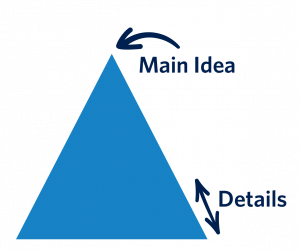
The topic is Adelie penguins. The single word “penguins” is too broad, because the author isn’t writing about all different kinds of penguins; they are only writing about Adelie penguins.
Once the topic has been located, the main idea can then be found. To figure out the main idea, ask this question: What is being said about the person, place, thing, or idea (the topic)?
The main idea can be located in different places within a paragraph. It is usually expressed in a sentence, and it is commonly in the first sentence. The writer then uses the rest of the paragraph to support the main idea through including relevant details.
Let’s use the paragraphs below as examples. First, find the topic, then look for the main idea and then the details.
| New York City is an interesting city because of its diverse cultural experiences. The city is home to a vibrant tapestry of communities, each contributing unique traditions, foods, and festivals. Walking through neighborhoods like Chinatown, Little Italy, and Harlem offers a taste of the world in a single city. Visitors can enjoy diverse cuisines, from savory dim sum to rich cannoli, and experience cultural celebrations such as the Lunar New Year and the Puerto Rican Day Parade. New York City’s diverse cultures make it a fascinating and enriching place for everyone (OpenAI, 2024). |
|
Other Main Idea Locations
While the main idea is usually in the first sentence, the next most common placement is in the last sentence of a paragraph. The author gives supporting information first and then makes the point in the last sentence.
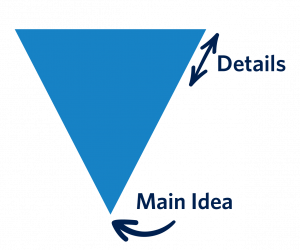
Here’s a paragraph we can use as an example – try to locate the topic and the main idea.
| Most teenagers and young adults do not know what they want to do for the rest of their lives. It is a big decision. There are a number of things they can do to narrow the choices. For example they can take an interest test, do some research on their own about a career, try volunteer work in the field in which they are interested, or “job-shadow”, in which they spend a day with a person who is working in a field that interests them. These are just a few helpful ideas as young people begin to choose a career path. |
|
Finally, an author might put the main idea in the middle of a paragraph. The author will spend a few sentences introducing the topic, present the main idea, and then spend the rest of the paragraph supporting it. This can make the main idea more difficult to find.
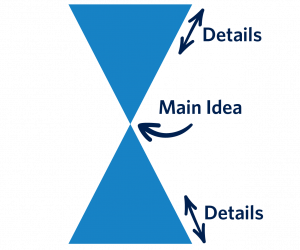
See if you can find the topic and main idea in the paragraph below.
| The United States seems to be in love with the idea of going out to eat. Because of this, a real variety of restaurants have opened specializing in all kinds of foods. McDonald’s is the king of a subgroup of restaurants called fast-food restaurants. Chances are, no matter where you live, there is a McDonald’s restaurant near you. There is even a ski-through McDonald’s in Sweden! Now, McDonald’s is trying something new. It is called McDonald’s Express, and there is a test site in Peabody, Massachusetts. It is part of a Mobil gas station. This allows you to fill up with gas and fill up on food at the same time. What will they think of next? |
|
To strengthen students’ reading comprehension, it is important to highlight how paragraph structure works. Students should be shown models of paragraphs that demonstrate different placements of the main idea and the details. Students should then practice identifying both the topic and the main idea in these varied examples. This approach helps students gain a clearer understanding of how written text is organized, which in turn supports their ability to comprehend and analyze what they read.
Overall, when students can effectively identify topics and main ideas, they can more easily comprehend the point of a text or lecture. These prerequisite skills provide the backdrop for managing academic language and information.
Reference
Shanahan, T., Callison, K., Carriere, C., Duke, N. K., Pearson, P. D., Schatschneider, C., & Torgesen, J. (2010). Improving reading comprehension in kindergarten through 3rd grade: A practice guide (NCEE 2010-4038). Washington, DC: National Center for Education Evaluation and Regional Assistance, Institute of Education Sciences, U.S. Department of Education. Retrieved from whatworks.ed.gov/publications/practiceguides.